I was reading through the Metro Times and an article on The Pot Issue caught my eye. The article by Sandra Svoboda weeds through the stymied research behind medical marijuana and touches on several areas of this often misunderstood plant.
‘Lone wolf’
Part of marijuana’s “lone wolf” status in the prescriptive drug research world is because, well, it is one.
“I think one of the most interesting aspects of marijuana is that it’s dissimilar to so many other drugs that are classified as drugs of abuse,” says Randy Commissaris, an associate professor of pharmaceutical science at Wayne State University. “Marijuana is in a chemical class by itself. Marijuana is the only compound there. It’s not part of a family of drugs and it interacts with the body in a way that’s unique to marijuana.”
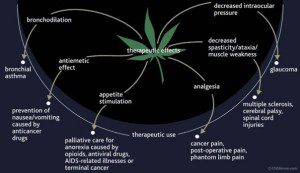
Therapeutic Effects of Cannabis
Opiates — for example, morphine and codeine — work as heroin does, interacting with the body’s opiate receptors. Benzodiazepines — including Valium and Xanax — decrease abnormal excitement in the brain like barbiturates do as well. Both classes of drugs work with a protein molecule in the body. But THC has a unique pathway: The THC receptor is activated when cannabis is smoked, inhaled or orally ingested.
There is “a unique protein called a THC receptor in the brain, but also in other parts of the body, where it interacts and produces the effects,” Commissaris says.
In its official materials, the NIH’s National Institute on Drug Abuse finds that cannabinoids — compounds that bind to the same receptors as THC — “have great potential for treating a number of disorders, including addiction, obesity and pain, among others.”
Comparison of drugs
But the FDA still regards marijuana as having high abuse potential with no currently accepted medical use because marijuana is classified as a Schedule I drug under the Controlled Substances Act as passed by Congress. Until that’s changed, the federal agency’s hands are tied, and that means approval for therapeutic studies is limited. Still, the Center for Marijuana Research at the University of California-San Diego managed to get 15 clinical trials approved during the last decade. Funded by the state, the center oversaw experiments showing therapeutic benefits for pain control related to spinal cord injuries or nervous system diseases including HIV. People with multiple sclerosis also showed some benefit from marijuana in controlling muscle spasticity.
Some study participants experienced side effects, but researchers noted that these were not much different than what would be expected with other drugs.
J. Hampton Atkinson, a center co-director, says researchers realize the limits to their work. They didn’t, for example, study long-term cannabis use, which he says other research has linked to bronchitis and upper respiratory tract ailments. Smoking marijuana, though, Atkinson says, doesn’t have the same link to lung cancer.
One of these things is not like the others?
“I’m not saying, ‘There’s something wonderful about cannabis, it won’t give you lung cancer.’ I can certainly believe that smoking any plant material, if you do it long enough, you’re in for trouble,” he says. “But there isn’t that, for whatever reason, maybe the amount of exposure, maybe something else, there isn’t that link with smoking marijuana as there is with tobacco.”
The article adds insight from an associate dean the University Maryland School of Law who has written about marijuana law for the New England Journal of Medicine, spokeswoman for the National Institutes of Health, along with the professor of rehabilitation medicine and co-director of the Muscular Dystrophy Association/Amyotrophic Lateral Sclerosis Center at the University of Washington.
Jay Selthofner is the Founder of The Wisconsin Cannabis Activist Network and Northern Wisconsin NORML. Jay ran for Wisconsin State Assembly 2010 as an Independent Candidate on a platform of legalizing cannabis.
He owns Selthofner Consulting which provides a wide array of services. His family owns Heritage Hemp Farm, which specializes in a compassion club style setting for their patrons and holds the annual "From the Land Festival" in Green Lake, WI, the third weekend in October.
Jay is also a contributor to The Stoner's Travel Guide and with the help of cannabis activists Gene and Jessica, they are about about to publish the book The Stoner's Travel Guide to Wisconsin which will include a business directory. If interested in advertising opportunities, please do not hesitate to contact Jay for a media kit.
Jay is a motivated citizen activist in Wisconsin. Through networking, communication and hard work he believes the reform of cannabis laws will progress despite relentless opposition.