Testin vs Swearingen Committee Death Match

Rob Swearingen and the New Hemp Bill
Rep. Swearingen has had many chances to be a team player and instead of giving some love to his colleagues and a bill that could actually pass, he still is pitching his bill and is now being labeled the “The Wisco Mitch“. No doubt a word play influenced by the recent “federal hemp ban kingpin” Mitch McConnell and the word bitch.
Rep. Rob Swearingen, a Republican from Rhinelander, is the primary author and sponsor of AB 606 (SB 681)— a sweeping bill that would dramatically change how hemp-derived cannabinoid products are regulated in Wisconsin. As chair of the Assembly’s Committee on State Affairs, Swearingen effectively controls which bills receive hearings and advance. Under his leadership, AB 606 was sent to his committee, setting the stage for a fast-tracked process.
AB 606 would rename the state’s “Division of Alcohol Beverages” to the “Division of Intoxicating Products,” placing hemp-derived products (including THC/cannabinoid products) under the same regulatory umbrella as alcohol.
The bill would impose a “three-tier licensing system” similar to the alcohol distribution model: separate licenses and burdens for growers, processors, distributors, and retailers. This means costly permits, inspections, and taxes — including “occupational taxes” on hemp-derived cannabinoid products.
Opponents warn that this “over-regulation, not legalization” approach threatens small farms and businesses, could push out local operators in favor of large distributors or out-of-state companies, and may even force the closure of vertically integrated hemp farms.
The Broader Context: Upheaval & Alternative Legislation
The introduction of AB 606 (SB 681) comes amid a chaotic legislative session in 2025–26, where numerous hemp and hemp-derived regulation bills have been circulating. According to a recent overview, AB 606 is part of a sequence of four major bills affecting Wisconsin’s hemp industry — including proposals to ban intoxicating hemp products entirely.
Notably, a competing proposal sponsored by Patrick Testin and Tony Kurtz is now circulating for co-sponsorship. That bill — the fourth in the sequence — is being described (by its proponents) as potentially more moderate, or at least as a political pivot away from outright bans or heavy-handed regulation.
Yet so far, Swearingen has not publicly endorsed this Testin/Kurtz proposal — the one that some in the industry view as the “best, most common-sense written bill” currently on the table.
This reluctance has sparked concern and frustration among hemp farmers, small business owners, and industry advocates. Many view Swearingen’s insistence on AB 606 — despite the availability of a seemingly more pragmatic alternative — as stubborn adherence to a flawed system that threatens Wisconsin’s hemp economy.
Swearingen’s History: From “Tavern League” to Hemp Regulator

Assembly (R – Rhinelander)
To understand why Swearingen champions AB 606 / SB 681 — and why many distrust his motives — it helps to look at his background. Before joining the Assembly in 2012, Swearingen served as president of the Tavern League of Wisconsin (TLW), a powerful lobbying group representing bars, taverns, and alcohol-related businesses.
Many activists and writers now view that background as a potential conflict of interest: Here is a former alcohol-industry leader helping draft legislation that would regulate hemp products as though they were alcohol — thereby extending the influence of the alcohol distribution system to a very different industry.
Indeed, over the years, Swearingen has repeatedly blocked cannabis reform efforts. As chair of the Committee on State Affairs, he has killed multiple bills related to medical marijuana or adult-use legalization.
Even when public support in his district was strong — for example, a 2019 constituent survey showed 63% supported medical marijuana — Swearingen reportedly ignored those results and continued to oppose reform.
In a deeper sense, critics argue, this new hemp-regulation bill is not about consumer safety or sensible oversight — it’s about control. It looks like an attempt to fold a growing, independent hemp industry into the old alcohol regulatory regime — one whose vested interests historically have opposed marijuana or competing intoxicants.
What’s at Risk: Farmers, Small Business, Consumers
If AB 606 / SB 681 passes as written, the consequences could be severe for many in Wisconsin’s hemp ecosystem:
- Small and medium-sized hemp farms and processors may be unable to afford the licensing, fees, and regulatory burden — leading to closures or bankruptcies.
- Vertically integrated operations (grow, process, sell) — a common structure in the hemp industry — would effectively be outlawed, because alcohol-style three-tier laws prohibit combined manufacturing, distribution, and retail under one business.
- Consumers could lose access to hemp-derived cannabinoid products sold currently — or face significantly higher prices due to taxes and compliance costs shifting to the consumer.
- Wisconsin’s hemp heritage — once viewed as an emerging agricultural and economic opportunity — could be stunted or reversed just as it was gaining steam.
Many industry stakeholders and advocates criticize AB 606 as a “power grab” by alcohol-distribution interests rather than a genuine effort to regulate hemp responsibly.
Why Swearingen Still Pushes It — And Why His Colleagues Offered a Different Path
From Swearingen’s vantage point, folding hemp into the alcohol regulatory framework might seem like the simplest path to “bringing order” to a previously chaotic industry. Given his background, he may view a three-tier system as familiar territory.
But the reality — as many within the hemp industry point out — is that hemp-derived cannabinoid products and alcohol are fundamentally different. Hemp has agricultural roots; many products are tied to small farms, vertically integrated operations, and emerging businesses selling goods nationwide. Treating hemp like liquor ignores these structural differences and risks dismantling the progress made over the past years.
That’s why other lawmakers — like Testin and Kurtz — floated a different proposal. Their draft (the “fourth hemp bill”) is being circulated for co-sponsorship and is often described within industry circles as the more reasonable or “common-sense” approach for regulation, rather than prohibition or heavy-handed alcohol-style oversight.
So far, though, Swearingen has not backed, endorsed, or even publicly acknowledged that alternative. His continued support for AB 606 — despite the rising backlash from hemp farmers, small businesses, and reform advocates — has many questioning whose interests he’s truly protecting.
A Choice Between Control and Growth
The state of Wisconsin — and particularly its hemp community — now stands at a crossroads. On one side is AB 606, championed by Rob Swearingen: a proposal that would essentially subsume hemp under old alcohol-industry regulation, potentially crushing small growers, retailers, and a budding local economy. On the other side is a newer, alternative proposal from Testin and Kurtz that some view as a more honest, workable attempt at regulation — one that does not punish hemp simply for being hemp.
Whether Swearingen will pivot — or double down — remains to be seen. But given his past record of blocking cannabis reform, and his clear ties to the Tavern League and alcohol regulation interests, many remain deeply skeptical.
For Wisconsin’s hemp entrepreneurs and consumers, the stakes are high. The next few weeks and months could determine whether this industry survives — or is crushed under the weight of ill-fitting regulation, or even worse, made illegal again under the looming federal hemp ban. Please give a Facebook and Instagram follow to the Wisconsin Cannabis Activist Network (Instagram) and the Wisconsin Hemp Farmers and Manufacturing Association (Instagram) for up to date movements on the issue of hemp cannabis reform.
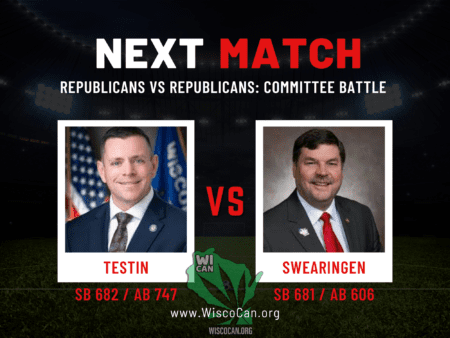
Swearingen controls the committee
Interesting enough, Testin’s bill will go directly to the Senate Committee on Agriculture and Revenue, which he chairs. That all but assures his bill will receive a public hearing in the Senate. The other members of this committee are Senators Tomczyk (co-sponsor of three tier bill), Senator Marklein (cannabis hater), Senator Cabral-Guevara (420 friendly) and Senator Jacque (cannabis hater). The Democrats on the committee are Senators Pfaff (co-author of the three tier bill), Senator Spreitzer (long time supporter of reform) and newly elected Sarah Keyeski (she was absent from the Democrats version of hemp regulation).
But the Assembly Leadership sent the bill to Rob Swearingen’s committee, the Committee on State Affairs. Swearingen has already held a public hearing on the Linde Brill bill to ban/redefine hemp and he also held a public hearing on his own bill, the Three Tier Bill. This committee assignment puts all eyes on Assembly Representative Rob Swearingen, who, in recent main stream media coverage is still pitching his bill as the solution and has not mentioned the Testin/Kurtz bill.
In past sessions, bills to legalize and regulate cannabis have continually stalled out under the careful watch of Rep. Swearingen.
I think this sets up an interesting situation. Will Testin do a trade and allow a pubic hearing on the Three Tier Bill while holding a hearing on his own bill? That set up could, if the bills are heard consecutively in a public hearing, set the stage for something special. But if a pissing match happens between Testin and Swearingen (or the overall Senate vs Assembly), Swearingen could just let the Testin Kurtz bill sit idle and die in his (Swearingen) committee.
All eyes on Republican Rob Swearingen
As the 2025-26 Legislation Session comes to a quick close, all eyes are on the 34th Assembly District and Republican Rob Swearingen. Will his own selfish nature and hate of cannabis kill everything or will he play ball with his fellow Republicans? The Republican party is truly divided on the issue. There are basically four categories of Republicans right now, based of my opinion, understanding of these people and co-sponsorship analysis of the three bills the Republicans have offered this session. Here is how I look at them.
- There are Republicans who want to ban all intoxicating hemp (and CBD) and are labeled prohibitionists.
- There are Republicans who are going along with the Three Tier System (these are big government, spend and tax Republicans)
- There are Republicans who lean more towards liberty, freedom, less government interference and don’t like new taxes.
- There are Republicans who have not taken a stance on hemp reform and have never sponsored a bill on the subject.
As we see by the three drastically different bills presented, the Republicans are divided on the issue. Going into the 2026 Election without solving anything is only going to help the Democrats. The Republicans control the law making progress right now and the fact that they cannot even work together within their party on an issue the overall public supports is not only a tragedy, it could be their down fall going into the next election cycle.
The Republican front runner for Governor has a horrible track record on cannabis reform. The Republican front runner for Attorney General has a horrible track record on cannabis reform. Congressman Tom Tiffany and District Attorney Eric Toney are not expected to help hemp if elected and maybe that is why the Republicans in the state legislator are so hesitant to do anything on cannabis.
That is a mistake and if they fail to act, it just gives the Democrats plenty of ammunition and opportunities to show how out of touch Republicans are with the citizens of the state. Bottom line is this, if the Republicans do not get their shit together, soon, they will look like shit on the issue come election time.
Back to Swearingen and his district. All eyes and focus should be on Swearingen, we should be in his district directly, holding events, meetings and garnering support for AB 747 / SB 682 right in this guys backyard (and in the backyard of his co-sponsorship cronies). Swearingen has represented the district since 2013.
Vote him out?
I always hear in the comments on social media when I put out these articles and calls to action, one common comment, the “vote him out”. Swearingen will be up for re-election in 2026, as will all 99 Assembly Reps in Wisconsin, but based off my analysis, the 34th is a Solid Republican District with +17 points in most election stats. In 2024, Swearingen won by over 11,000 votes with 64% of the vote going to him. In 2022 the Democrat candidate was very supportive of cannabis reform and later became an activist with the Wisconsin Cannabis Activist Network, but she did not come close to winning either. In 2020 the Democrat was Kirk Bangstad from the Minocqua Brewing Company and well, that guy is still making the news about his fight with area Republicans.
Swearing has never faced a primary challenger as an Incumbent. The only primary he ever had to run was back in 2012. Swearingen won election in the 2012 election for Wisconsin State Assembly District 34. He defeated Alex Young in the Republican primary on August 14, 2012. Primary elections are the key to making change within the ranks of Republicans. The unwritten rule of not challenging a fellow Republican in a primary has to end, it has to end now! Back then, in 2012, only 6,941 votes were cast in the Republican primary, with Swearingen taking 74% of the vote.
Sources: RPubs, CNanalysis (Solid Rep +17) WisPolitics /2024 Assembly Races (61% Rep), Davesredistircing, PeoplesMaps, Ballotpedia
Where is the 34th Assembly?
Located in northern Wisconsin, the district comprises all of Vilas County and most of Oneida County. It contains the cities of Rhinelander and Eagle River and most of the Lac du Flambeau Reservation. It also contains parts of the Nicolet National Forest, including the Blackjack Springs Wilderness.
Let’s go! I say prepare your written testimony against SB 681/AB 606 now as well as prepare your written testimony for support of SB 682/AB 747 and use that in lobbying efforts currently under way. If you need some laser direct focus on the who’s who and where to concentrate, please reach out.
As always, thank you for the past support! If you are interested in sponsoring my 2026 Election Coverage, sponsorships are now open. Thank you to the all the businesses (and The Wisconsin Libertarian Party) for already coming aboard as sponsors! Another option to help is to come to my dispensary in Ripon and buy some supplies. Our store is stocked with products of the companies that are election coverage sponsors. You can also shop online on any of my affiliate programs I have partnered with. And last but not least, you can buy the new book I co-authored which is The Stoner’s Travel Guide to Wisconsin.