The Green Side to the Blue Wave

More than 1 million Wisconsin adults consume marijuana. David Crowley just won the governor’s race with 1.44 million votes. Democrats swept control of the Wisconsin Legislature. Is it time to recognize the cannabis constituency as a potentially significant part of Wisconsin’s changing political landscape?
Wisconsin just experienced a political earthquake.
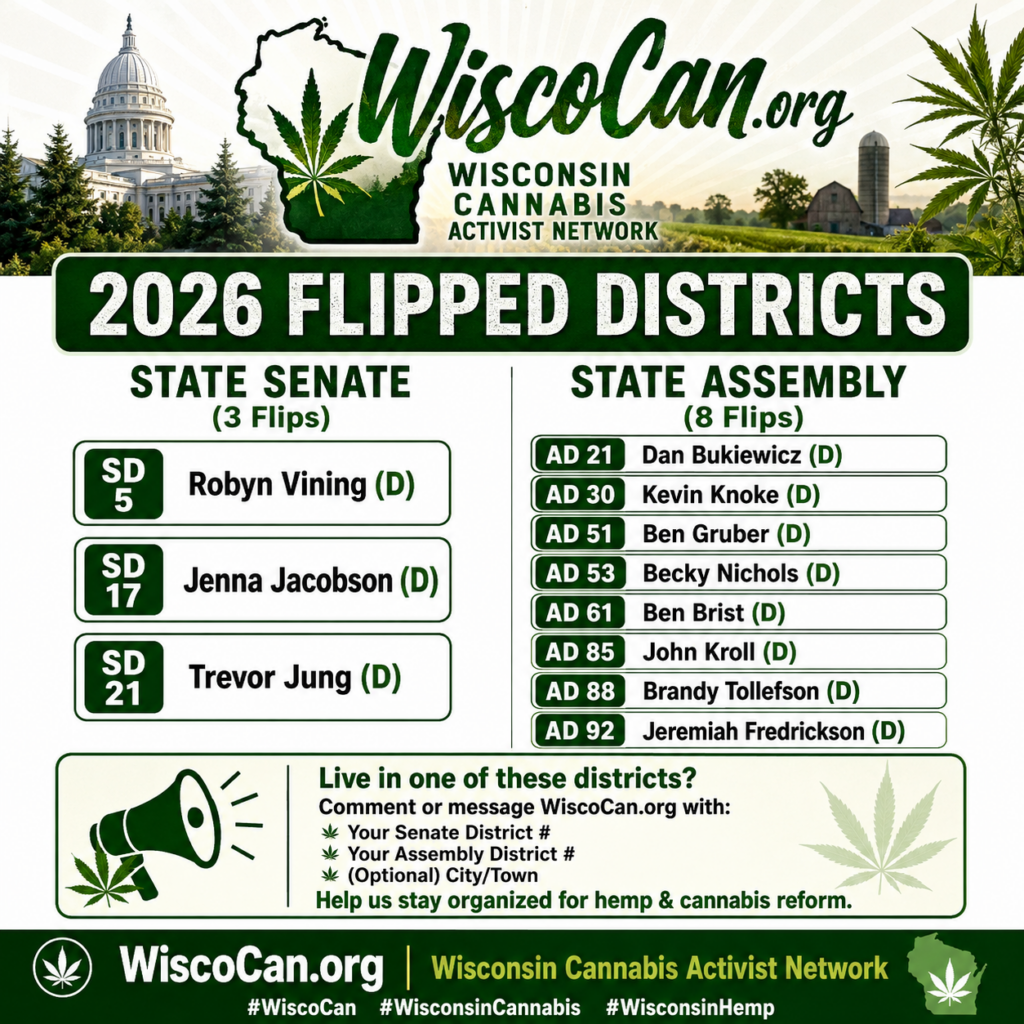
On November 3, 2026, Democrat David Crowley defeated Republican Tom Tiffany in the race for governor, Democrats flipped both chambers of the Wisconsin Legislature, and Republicans lost their long-standing grip on state government.
The headlines are calling it a blue wave.
But perhaps there is another color worth adding to the conversation.
When you mix blue and green, you get teal.
And Wisconsin may have a substantial green constituency that is increasingly difficult for politicians to ignore.
At WiscoCan.org, we’ve spent years following the cannabis issue, candidate positions, legislative votes, and the growing disconnect between Wisconsin’s cannabis consumers and the policies coming out of Madison. The 2026 election provides an opportunity to look at that disconnect through a different lens.
Start With the Numbers: Crowley vs. Tiffany
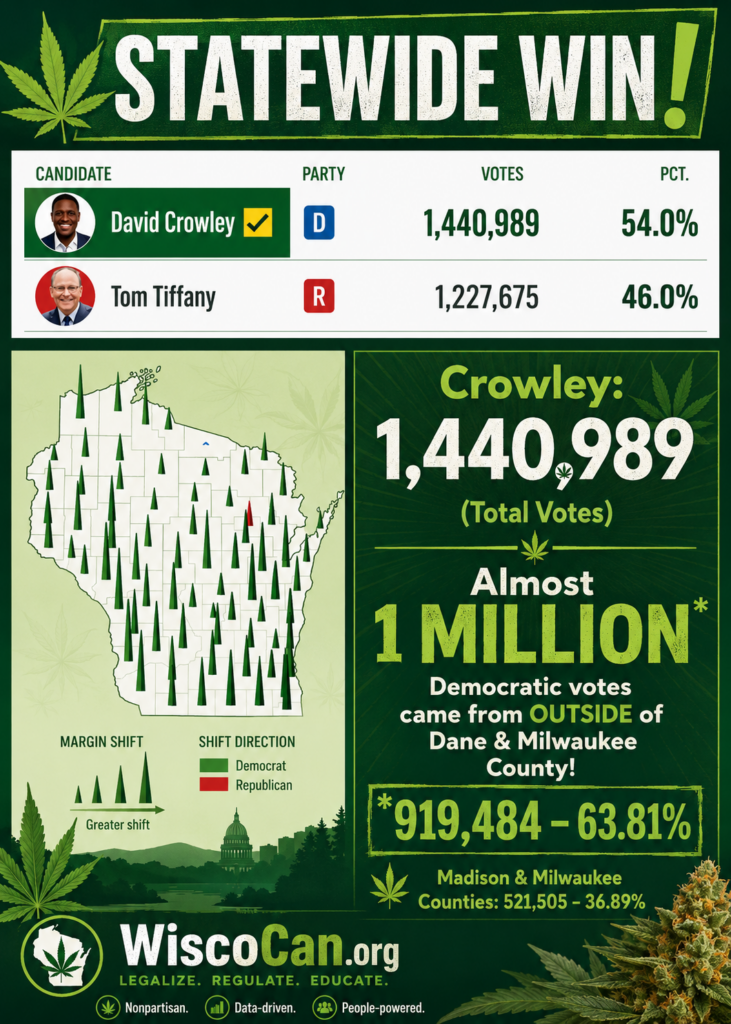
David Crowley won statewide with 1,440,989 votes, compared with 1,227,675 for Tom Tiffany.
That’s an approximately 213,314-vote victory and a statewide result of 54% to 46%.
Now let’s look beyond Wisconsin’s two largest Democratic strongholds.
The Milwaukee and Dane County Factor
Crowley received:
- Milwaukee County: 271,129 votes
- Dane County: 250,376 votes
- Combined: 521,505 votes
That means approximately 36.2% of Crowley’s statewide vote came from these two counties.
But here’s the number I find particularly interesting:
919,484 votes for David Crowley came from outside Dane and Milwaukee counties.
That’s approximately 63.8% of his entire statewide vote.
These numbers challenge the simplistic narrative that Democrats can only win Wisconsin by running up enormous margins in Madison and Milwaukee.
Crowley needed votes from across the state, including rural communities, smaller cities, suburban areas, and traditionally competitive political territory.
The cannabis constituency is not confined to Madison and Milwaukee either.
Note: Election results are unofficial and subject to final canvass and certification.
umers
According to the federal Substance Abuse and Mental Health Services Administration (SAMHSA), approximately 1,059,000 Wisconsin adults reported using marijuana within the previous year in its 2023–2024 National Survey on Drug Use and Health.
Another approximately 679,000 adults reported marijuana use within the previous month.
| Adult marijuana consumption | Estimated population |
|---|---|
| Past 12 months | 1,059,000 |
| Past 30 days | 679,000 |
Source: SAMHSA – Wisconsin 2023–2024 State Estimates.
Consider that for a moment.
Wisconsin has an estimated 1.06 million adult marijuana consumers, while Crowley received approximately 1.44 million votes statewide.
Those are two enormous numbers representing populations that overlap, but they are not interchangeable. Not every cannabis consumer is registered to vote, not every consumer supports legalization, and certainly not every cannabis consumer voted for Crowley.
Nevertheless, the potential political significance is difficult to dismiss.
Did Cannabis Help Create the Blue Wave?
We cannot assign a specific number of Crowley votes to marijuana consumers without reliable voter surveys or exit polling that measures cannabis consumption and vote choice.
But there are some important political circumstances worth examining.
First, cannabis legalization was a clear point of difference between the two gubernatorial candidates.
Crowley publicly supported full adult-use legalization, pointing to economic opportunity, consumer choice, and the revenue Wisconsin is losing to neighboring states. Crowley has a proven record of legislative support also, which we have documented over the years.
Tiffany favored a more gradual approach, beginning with medical marijuana rather than immediately establishing a comprehensive adult-use market. Tiffany’s 2026 campaign stance on cannabis reform did not have the same positive legislative track record to rely on. Additionally, hemp cannabis industry stakeholders felt like Tiffany could have done so much more for the intoxicating hemp / hemp derived cannabinoid market during his last term and addressed the issue during his campaign.
Second, independent voters became increasingly important to Crowley’s campaign. The October Marquette Law School poll found Crowley leading Tiffany 56% to 26% among likely independent voters.
Third, cannabis reform is not exclusively a Democratic issue. Wisconsin has marijuana consumers, hemp entrepreneurs, farmers, veterans, caregivers, and reform advocates across the political spectrum.
The opportunity for candidates is to recognize that cannabis policy can bring otherwise disconnected voters together.
A Republican farmer concerned about agricultural opportunity, an independent consumer frustrated by prohibition, a veteran seeking medical alternatives, and a Democrat advocating criminal justice reform may not agree on much else. But they may have common ground on cannabis policy.
That is where the green wave becomes politically interesting.
The Teal Wave: A Constituency Bigger Than Either Party
The mistake Wisconsin politicians have made for years is treating cannabis reform as a niche issue.
It isn’t.
More than one million adult consumers represent a substantial potential constituency. Add their families, friends, business relationships, employees, and communities, and the reach of cannabis policy extends considerably further.
And this isn’t just about recreational marijuana.
Wisconsin’s hemp industry is facing major regulatory questions. Small businesses need certainty. Farmers need opportunities. Consumers need protections. Medical patients deserve meaningful access. Communities need a serious conversation about responsible regulation instead of continued prohibition.
The 2026 election demonstrated that Wisconsin voters are willing to change the political landscape.
Now the question is whether the newly elected leadership will recognize the opportunity in front of them.
The Next Legislative Session Starts With Recognizing the Cannabis Vote
WiscoCan has consistently argued that cannabis reform needs a stronger, more organized voice in Wisconsin politics. We still believe in the formation of The Wisconsin Cannabis Caucus. We still believe friendly Republicans deserve a seat on The Wisconsin Cannabis Caucus and urge leaders of both parties to create this caucus before the 2026 legislative session ends. There is still a “skinny hemp bill” that could take an entire industry off edge should it pass before the November and December 2026 federal hemp changes take hold.
If Republicans are listening to voters, the lame duck session should address hemp and hemp derived cannabinoid products at a very minimum. Decriminalization of possession, growing and sale of hemp cannabis should also be immediately addressed and passed in a lame duck session.
The 2026 election should be a wake-up call for candidates of both parties.
There are more than one million adult marijuana consumers in Wisconsin. There are hundreds of thousands of monthly consumers. There are businesses and agricultural interests that depend on sensible hemp and cannabis policy.
These people are not a political party. They are not confined to one legislative district. And they should not be taken for granted by either party.
Perhaps the blue wave of 2026 had a green side that deserves more attention.
Blue plus green makes teal. And Wisconsin’s emerging teal constituency could become an increasingly important force in future elections.
The question isn’t whether every cannabis consumer voted for David Crowley. The question is whether Wisconsin’s political establishment is finally ready to recognize the size, diversity, and potential influence of the cannabis constituency.
WiscoCan.org will continue tracking the candidates, elected officials, legislation, and political opportunities that will determine the future of Wisconsin cannabis policy.
The blue wave may have changed who controls Madison. Let’s see whether the green wave can help change what Madison actually does.
WiscoCan.org — Protect Wisconsin Hemp. Promote Cannabis Reform. End Prohibition.